

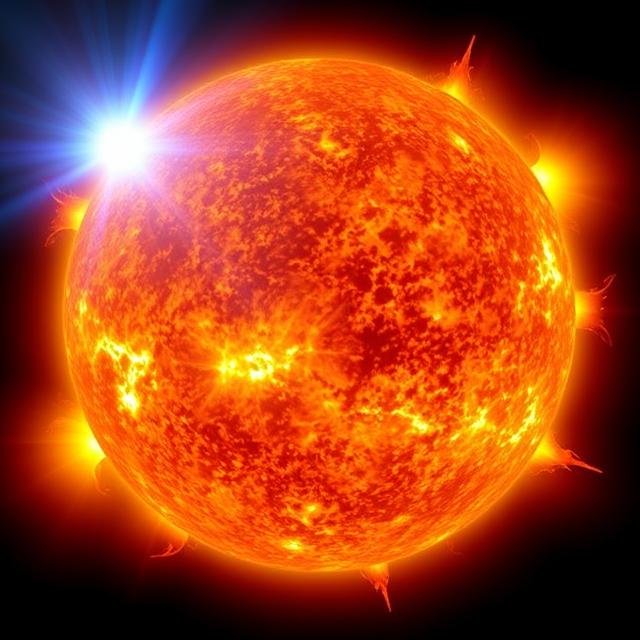
We’re excited to share the significant achievements of Dr. Stefano Scardigli in advancing the CORNERSTONE project’s mission to predict solar flares and space weather events.
What Did CORNERSTONE Accomplish?
Over the past months, Dr. Scardigli has developed a comprehensive integrated dataset that combines cutting-edge solar observations with historical event data—creating a powerful resource for machine learning applications in space weather forecasting.
Understanding the Data
To predict when the Sun will produce dangerous solar flares, we need to understand the magnetic fields in solar active regions (the areas where flares occur). Dr. Scardigli worked with data from two key sources:
Space-based Observations: High-resolution magnetic field measurements from NASA’s Solar Dynamics Observatory (SDO), specifically from the Helioseismic and Magnetic Imager (HMI) instrument. These measurements are packaged as “SHARP” data (Space-weather HMI Active Region Patches)—specialized data products that track active regions on the Sun and measure 17 different magnetic field parameters.
Historical Events: Over 52,000 solar flare events recorded by NOAA from 1996 to 2025, providing a comprehensive catalog of when and where flares occurred and their intensity.
The Challenge: Turning Raw Data into Science
The SDO/HMI instrument produces roughly 1.5 terabytes of data per day—more than any other NASA Heliophysics satellite. Dr. Scardigli’s work involved:
- Systematic data acquisition: Automatically downloading years of magnetic field measurements from Stanford University’s data repository
- Integration: Matching the magnetic observations with flare events using solar active region identifiers
- Quality control: Identifying and correcting data anomalies, including a systematic issue in 2013 data
- Normalization: Ensuring the measurements are comparable across different regions and time periods
- Feature engineering: Creating derived parameters that capture the physical conditions leading to flares
Why This Matters
This dataset provides machine learning algorithms with both the “before” picture (magnetic field conditions) and the “after” outcome (whether a flare occurred). This allows AI systems to learn which magnetic configurations are most likely to produce dangerous solar flares.
The work includes sophisticated classification systems for different flare intensities (C-class, M-class, and X-class) and prediction windows of 12, 24, and 48 hours—exactly what space weather forecasters need for practical applications.
Real-World Impact
This robust dataset supports both fundamental research and operational forecasting systems. Machine learning approaches using SHARP parameters have shown promising results in predicting solar flare activity, and Dr. Scardigli’s carefully curated dataset provides an optimal foundation for advancing these capabilities.
By combining data preparation expertise with rigorous quality control, Dr. Scardigli has created a resource that will benefit researchers and forecasters working to protect satellites, power grids, and astronauts from the Sun’s most powerful eruptions.
CORNERSTONE is funded under MUR – PRIN 2022 PNRR (P2022RKXH9 – CUP: E53D23021410001)