
A new CORNERSTONE’s recent work explores how physics-driven feature design can make solar flare forecasting not only accurate but also physically meaningful.
Physics-Informed Learning: Embedding Physical Consistency in AI
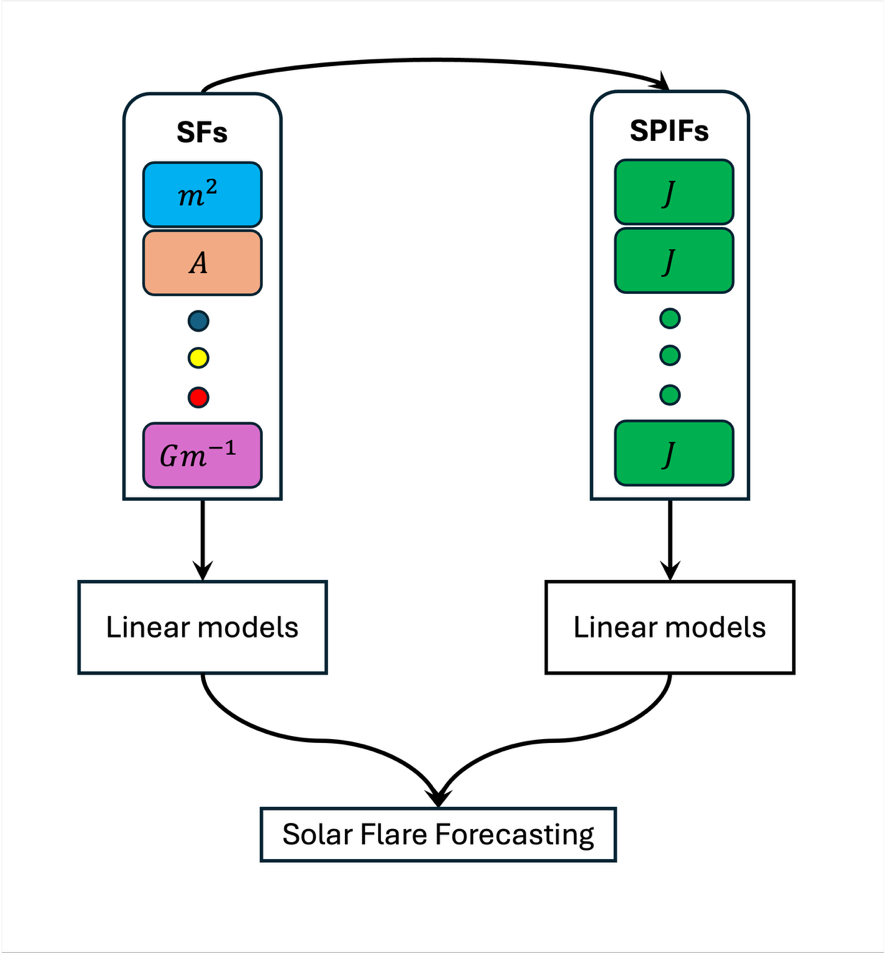
In most data-driven approaches to solar flare prediction, models are trained on sets ofStandardized Features (SFs) — numerical representations of solar magnetic activitynormalized for machine learning. The goal is typically a binary prediction: whether a flarewill occur within a given time window or not.
These features — though rich in information — differ in their physical units. Applying linear models directly to them means combining quantities that describe fundamentally different aspects of the magnetic field, which is statistically valid but physically inconsistent.
In this work, the standardized features are derived from the SHARP data recorded by the Helioseismic and Magnetic Imager (HMI) onboard NASA’s Solar Dynamics Observatory (SDO). To overcome the issue of dimensional inconsistency, these parameters are combined through operations that align their physical dimensions, yielding a new set of Standardized Physics-Informed Features (SPIFs). All SPIFs share the same unit of energy J.
This creates a physically coherent feature space, where each variable represents a comparable quantity. Linear operations on this space naturally lead to a clear physical interpretation, something not possible when using the raw SHARP parameters or the standard feature sets alone.
A Fairer and More Interpretable Framework
To investigate the practical implications of this approach, different machine learning models — Lasso, GroupLasso, Random Forest Regressor, and Support Vector Classifier — were trained and evaluated on both SFs and SPIFs. Performance was assessed using the True Skill Statistic (TSS), a standard metric in space weather forecasting.
The results were comparable between the two feature sets. However, using SPIFs provides the advantage of interpretability:
- Model coefficients and feature importance weights can be understood in terms of physical energy, rather than abstract statistical correlation.
- This makes the forecasting process fairer and more transparent, as predictions are grounded in physically meaningful relationships.
Why It Matters: From Physics-Aware Forecasting to Explainable AI
In the broader context of Explainable Artificial Intelligence (XAI), this work highlights how embedding physical reasoning directly into feature design enhances interpretability. Instead of treating AI as a “black box” that correlates arbitrary inputs, physics-informed learning constrains models to operate within the bounds of physical consistency — offering explanations that make sense both mathematically and scientifically.
This fusion of data-driven learning and physics-based understanding represents a crucial step toward reliable, interpretable solar flare forecasting—where models not only predict flares effectively but also explain why those predictions are physically sound.